What Hits a New Custom Domain in Its First Hour

A new custom domain gets probed for secret files within seconds of getting its certificate. We followed 129 new custom domains through their first hour on our proxies. On about half of them, something asked for /.env or /.git/config within 5 seconds of the certificate showing up in a public Certificate Transparency log. By the end of the hour, 122 of the 129 had been probed.
Nobody had linked to these domains yet. The bots found them in Certificate Transparency logs, where every trusted certificate gets published. And if you offer custom domains, your platform is the one publishing your customers' hostnames, usually before the customer has even opened the site.
What's in this post:
- A job board's first hour, second by second
- The numbers across 129 new domains
- Who shows up
- Why it happens
- What to do about it
A job board's first hour, second by second
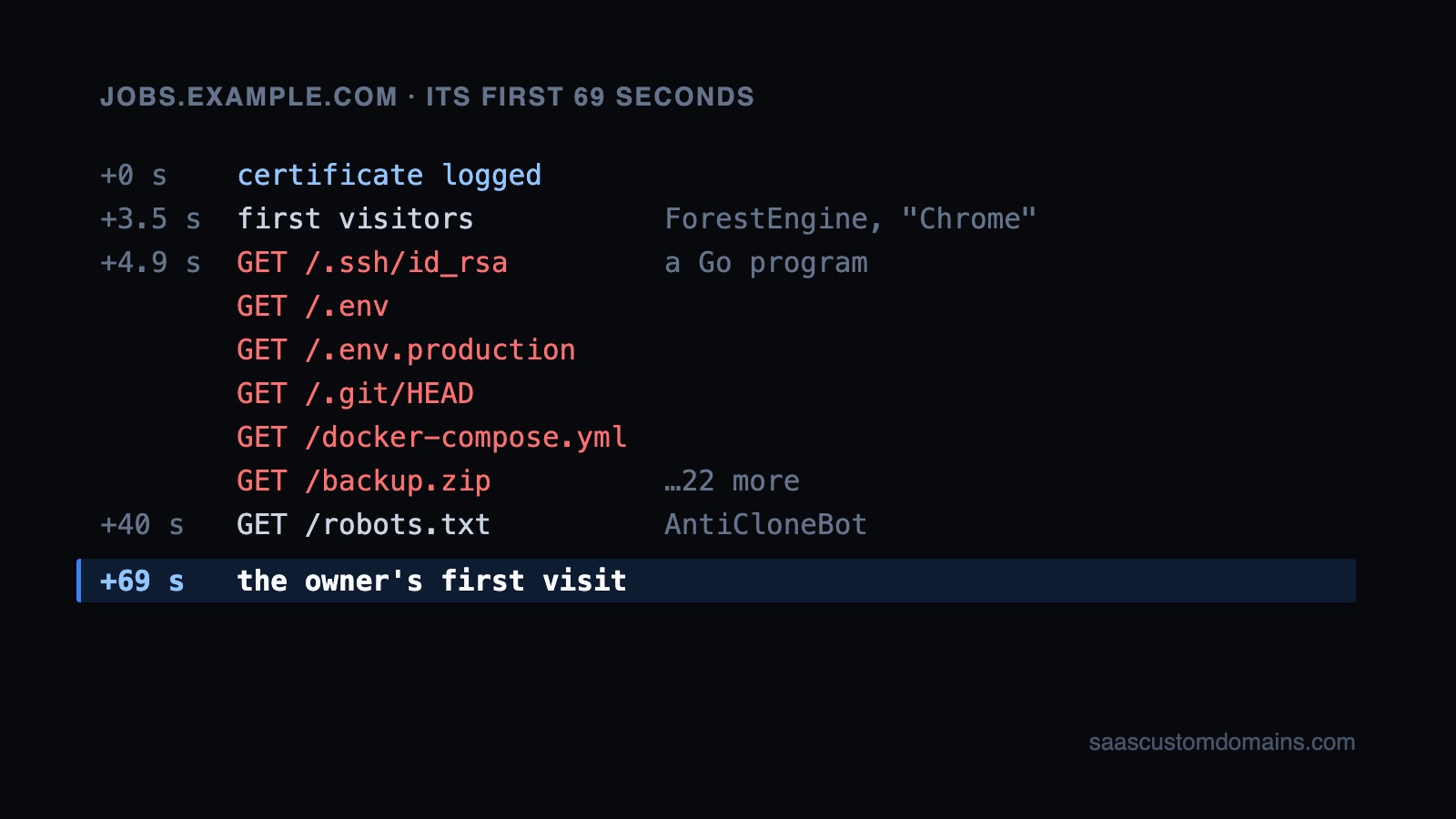
One of our customers runs a job board platform. People launch their own boards on their own domains, and our reverse proxies pass those domains' traffic to the platform's app. On November 14, a board owner connected a new subdomain. We'll call it jobs.example.com. Here's what our logs show, timed from the moment its certificate went public in the Certificate Transparency logs:
| Time (UTC) | After the certificate went public | What happened |
|---|---|---|
| 00:12:58 | The custom domain is added | |
| 00:40:10 | Let's Encrypt validates the hostname, 2.4 seconds before the certificate goes public: 14 requests from 12 IP addresses in five countries | |
| 00:40:13 | 0 | The certificate goes public: two Certificate Transparency logs record it, 0.13 seconds apart |
| 00:40:16 | +3.5 s | The first visitors: a crawler calling itself ForestEngine, and a client claiming to be Chrome on a Mac |
| 00:40:18 | +4.9 s | A Go program asks for /.ssh/id_rsa, then 27 more files in 1.5 seconds: .env, .env.production, .git/HEAD, docker-compose.yml, database.sql, backup.zip, storage/logs/laravel.log, secrets.json… |
| 00:40:53 | +40 s | AntiCloneBot fetches /robots.txt. Its user agent says it "finds copies of online shops and fake shops" |
| 00:41:22 | +69 s | The board's owner opens it for the first time, from a link in the platform's dashboard |
| 00:43:07 | +2.9 min | Another scanner sends 183 requests in 9 seconds, 173 of them for variations of .env, including tricks like //../../../.env |
| 00:44:51 | +4.6 min | Recorded Future's "Global Inventory Crawler" visits the home page |
| 01:27:20 | +47 min | ClaudeBot fetches /robots.txt |
Over the hour, the board got 306 requests from 29 IP addresses. The owner sent 42 of them. 194 asked for secret files, and those came from just two IP addresses. Most of the traffic, 249 requests, arrived in the first five minutes.
Nothing leaked, because the app answered all of those requests with errors. But look at the order: eight IP addresses had already visited, and one of them had asked for an SSH key, before the owner had even seen their own board.
In case you're wondering about the 12 validation addresses: Let's Encrypt checks a domain from several networks at once, so one hijacked network path can't fool it.
129 new domains, in numbers
The job board was typical. For the 109 domains where we know exactly when the certificate went public, this is how quickly the first request for a secret file arrived:
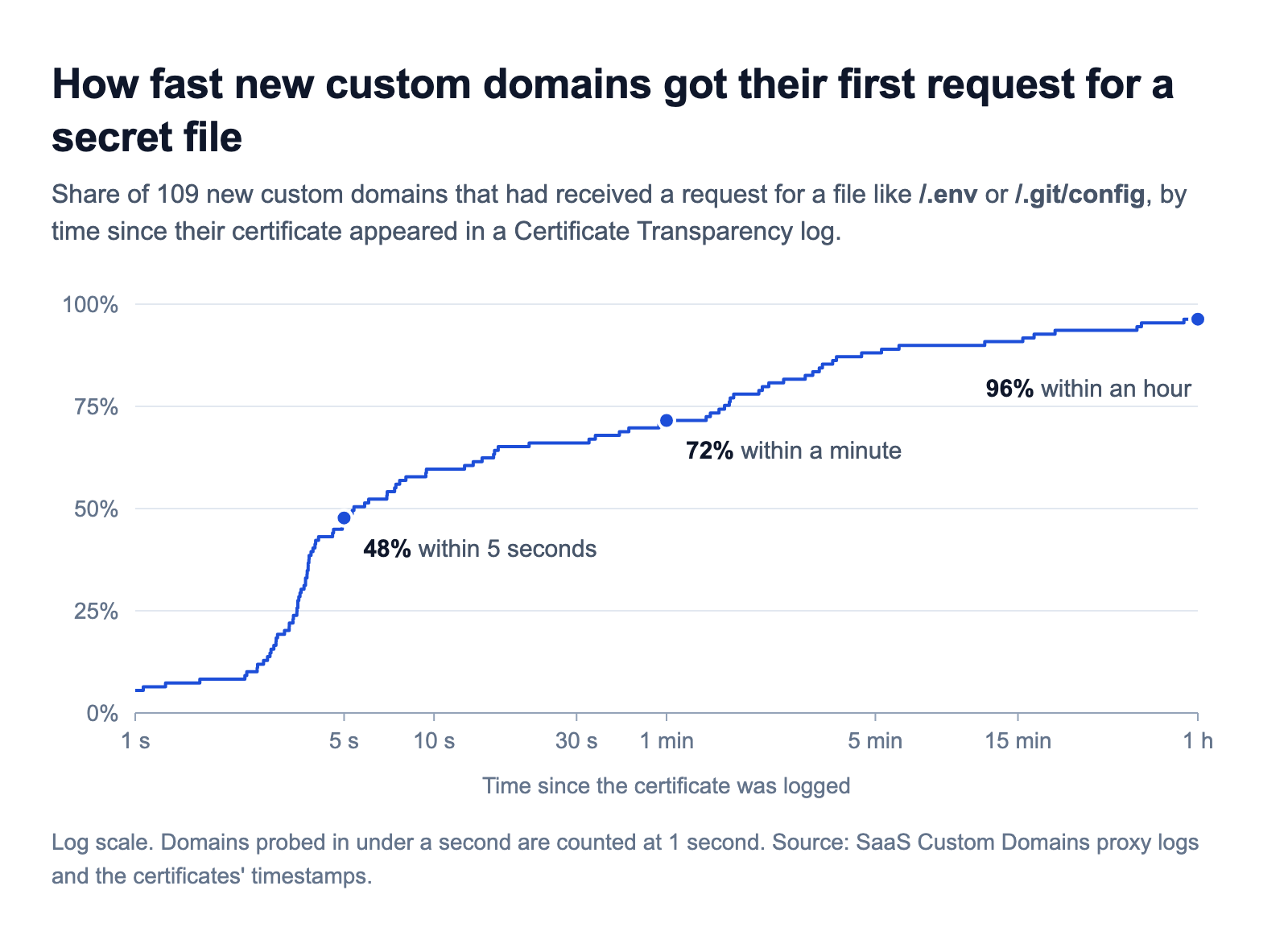
- Within 1 second: 6 domains
- Within 5 seconds: 48%. The median was 5.1 seconds.
- Within a minute: 72%
- Within an hour: 96%
Over the first hour, across all 129 domains:
- 95% got a request for
/.env, and 93% for something under/.git/. - 74% got WordPress probes like
/wp-login.phpand/xmlrpc.php. - 97% were asked for
/robots.txt. - The typical domain got 52 requests for secret files, from 4 different IP addresses.
How we picked and timed the domains is at the end, in How we measured.
What they asked for
These are the paths scanners asked for most, leaving out ordinary ones like / and /favicon.ico:
| Path | Domains (of 129) | What they're after |
|---|---|---|
/.env | 122 | Database passwords and API keys |
/.vscode/sftp.json | 105 | VS Code's SFTP settings, which can hold server logins |
/.git/config | 103 | An exposed Git repository, and from there the source code |
/phpinfo.php | 84 | A PHP configuration dump |
/@vite/env | 84 | A Vite dev server running in production |
/server-status | 83 | Apache's status page, with live requests and client IPs |
/actuator/env | 82 | Spring Boot's environment endpoint |
/docker-compose.yml | 81 | Service definitions, often with passwords |
/wp-config.php | 81 | WordPress database credentials |
/v2/_catalog | 79 | An open Docker registry |
/telescope/requests | 79 | Laravel Telescope's log of recent requests |
/.ssh/id_rsa | 72 | A private SSH key |
/storage/logs/laravel.log | 68 | Laravel's log file |
/actuator/heapdump | 67 | A Java heap dump, which can contain secrets held in memory |
One friendly path made the list too: /.well-known/security.txt, where a site lists its security contact (RFC 9116), was requested on 102 domains.
37 domains answered /.env with 200 OK, but every one we checked was just an ordinary HTML page from a catch-all route, not a real .env file. It's still worth fixing, because a security scanner your customer runs may report it as an exposed .env.
Who shows up in the first hour
Secret hunters
Most of them don't introduce themselves. They send Go-http-client, no user agent at all, or pretend to be a browser, which is normal for this kind of bot: in one study, 75% to 85% claimed to be a browser, but only 2% to 11% really were (Kondracki et al., 2022).
A few do use a name:
- LeakIX's
l9scanreached 80 of the 129 domains, usually about two and a half minutes in. - Something called
CT-WP-Scannerhit 30, usually within 7 seconds. We'd guess the "CT" stands for Certificate Transparency. TLM-Audit-Scanner/2.0sent 105,267 requests to 28 domains, nearly all from one IP address. It tried 5,582 different paths, like/config/master.key.bakand/stripe-credentials.json.
Security crawlers
Threat-intelligence and inventory crawlers name themselves too, and mostly fetch just the home page and robots.txt. ForestEngine reached 75 domains, usually within 7 seconds, Recorded Future's crawler reached 59, and one called Databot reached 89. Censys, the best-known internet-wide scanner, showed up on only 6, the first after 20 minutes.
AI crawlers
OpenAI's OAI-SearchBot, which finds sites for ChatGPT search, fetched robots.txt on 82 of the 129 domains within the hour. The first one came about 90 seconds in, and it asked for nothing else. The requests came from OpenAI's published IP ranges, so they're the real thing. OpenAI doesn't say how it finds new sites, but Ben Cox spotted the same pattern in 2025.
GPTBot fetched pages on 60 domains, and ClaudeBot on 66. Don't take any crawler's name on trust, though. GreyNoise has seen scanners use ClaudeBot's exact user agent to ask for .env files.
Search engines
Googlebot, checked against Google's IP ranges, visited only 14 of the 129 domains in their first hour. Bingbot visited one. Google says it finds new pages through links and sitemaps, not certificate logs.
Why it happens: Certificate Transparency
Certificate Transparency (CT) logs are public lists of every certificate that public certificate authorities issue, and entries can be added but never removed. They exist so domain owners can spot certificates they never asked for, and browsers enforce them: Chrome, Apple's platforms and desktop Firefox reject certificates that weren't logged. Let's Encrypt logs every certificate it issues.
Each certificate lists its hostnames, and anyone can read the logs. The CA even logs a draft of the certificate before it issues the real one, so in our data the hostname reached a log a median of 2.7 seconds after Let's Encrypt's validation check. In other words, the name is public before your proxy has even finished installing the certificate.
The logs have also gotten much faster. Let's Encrypt's current logs make a certificate readable before they even confirm it's been logged, or as they put it, "the effective merge delay is zero", and Chrome now requires new logs to add entries within a minute. Back in 2017, that took around 30 minutes. The scanners have kept pace:
| Data from | Study | First request after the certificate was logged |
|---|---|---|
| 2018 | Scheitle et al., 11 hostnames | 59 minutes at the earliest |
| 2021 | Pletinckx et al. | 84 seconds |
| 2021–22 | Kondracki et al., 4,657 certificates | 5.9 minutes on average, 12 seconds at the fastest |
| 2026 | This post, 109 custom domains | 5.1 seconds (median) to the first request for a secret file |
Let's Encrypt itself calls this traffic "normal and anticipated", and it doesn't only happen once: Pletinckx et al. saw a spike in DNS lookups for their domain every time its certificate was renewed. With 45-day certificates, every customer domain will get a fresh wave about once a month.
Can you hide a customer's domain?
Not really:
- Browsers reject certificates that weren't logged, so every domain your customers' visitors can open is in the logs.
- A proposal to hide hostnames in CT logs expired in 2017 and was never adopted.
- A wildcard certificate for
*.customer.comkeeps each subdomain out of the logs. But Let's Encrypt only issues wildcards through DNS-01 validation, so your customer has to delegate part of their DNS to you, and the wildcard itself is still public.
So the better question is what a new domain shows in its first minute.
What to do about it
Make sure the paths they ask for return nothing
A brand-new domain usually has no content of its own yet, and the scanners aren't after it anyway. They're betting that the app behind the domain left a file or an endpoint exposed. On a SaaS platform, every custom domain is served by the same app, so anything exposed on one of them is exposed on all of them. Check that none of the paths above returns anything real:
- Keep
.envfiles,.gitdirectories, backups and editor settings out of anything your web server can read. - On Spring Boot, keep Actuator endpoints off the public port.
- On Laravel, don't expose Telescope or
storage/logs. - On Nuxt and other Vite apps, never serve production from the Vite dev server.
Return 404 for secret files on every domain
Fixing this one tenant at a time doesn't scale. With SaaS Custom Domains, a rule on your upstream covers every customer domain behind it and answers at our edge, so the request never reaches your app. Here's one, created with our CLI, that returns a 404 for any path containing /.env:
npx @saas-custom-domains/cli rules create \
  --upstream app.yourapp.com --data @- <<'JSON'
{
  "name": "Block .env files",
  "matchers": [
    {"type": "path", "operator": "contains", "value": "/.env"}
  ],
  "handlers": [
    {"type": "static_response", "status_code": 404,
     "body": "Not found"}
  ]
}
JSON
Add a second rule for /.git/ the same way, or set both up in the dashboard. Rules can also block countries or IP ranges, serve a robots.txt, set security headers and rate-limit a login page.
Block by path, not by IP address. The typical domain got secret-file requests from 4 different addresses, one got them from 32, and the addresses change all the time.
Serve a robots.txt on every domain
97% of the new domains were asked for robots.txt within the hour. To a crawler, each custom domain is a separate site with its own crawl budget. Decide per tenant what it should say and serve it from minute one. A single rule can do that for every domain.
Don't let one scan slow everyone down
One scanner sent over 100,000 requests to 28 domains in an hour, and your backend gets all of it through your proxies. Per-domain limits and per-backend timeouts keep a scan of one customer's domain from slowing down the rest. That's one of our 12 reasons not to build custom domain SSL yourself.
How we measured
- The domains. We took custom domains recently added to SaaS Custom Domains that got a Let's Encrypt certificate. We kept the 129 whose very first request through our proxies was Let's Encrypt's validation check, so nobody had reached them through us before the certificate existed. They come from many different SaaS platforms, and a bit over half are subdomains.
- Time zero. For the timing figures, the earliest CT timestamp in each domain's certificate. That covers the 109 domains whose current certificate matched their first validation. For the counts, the hour after the first validation request.
- Secret files. Paths starting with
/.env,/.git/,/.aws/,/.ssh/,/.svn/,/.DS_Store,/.vscode/sftp.json,/.npmrc,/.htpasswd,/.bash_history,/wp-config.php,/phpinfo.php,/info.php,/server-status,/actuator/,/telescope/,/docker-compose.ymlor/storage/logs/laravel.log, or ending in.sql. - Who's who. User agents are easy to fake, so we checked OpenAI's crawlers and Googlebot against their published IP ranges. Other names are what the clients called themselves. Domains behind the customer's own Cloudflare proxy show Cloudflare's addresses.
- Limits. We only see traffic that reaches our proxies, and some hostnames may have had certificates elsewhere before. Our clocks and the logs' clocks differ slightly: one request arrived 0.4 seconds before the log's timestamp. We don't publish domain names, and the job board's domain is changed.
Custom domains with the edge already in place
SaaS Custom Domains issues and renews certificates for your customers' domains and proxies their traffic to your app. That puts the first-hour traffic at our edge, where you can handle it once for every domain:
- Rules to return 404 for secret files, serve a
robots.txt, block countries or IP ranges, set headers and rate-limit paths - Per-domain limits and circuit breakers, so a scan of one customer's domain doesn't slow down the others
- The Domain Analytics add-on, which separates bots and data-center traffic from real visitors on each domain
- The domain your visitor used, in a header, with a secret token so your app knows the request came through us
It costs $0.29 per domain per month, and $29/month covers your first 100 domains. See pricing for volume discounts and add-ons.
Frequently asked questions
Why is my new domain getting requests for /.env?
Its certificate was published in Certificate Transparency logs, and bots watch those logs for new hostnames. They ask for /.env because it often holds database passwords and API keys. 95% of the new custom domains we watched got such a request within an hour. Keep the file out of your web root and make sure the request gets a 404.
How do bots find a new subdomain so fast?
Browsers only trust certificates that are logged in public CT logs, and each certificate contains its hostname. Let's Encrypt's logs make new entries readable right away, so bots can send requests within seconds. Half of the domains we watched were probed within 5 seconds.
Can I keep a new hostname out of Certificate Transparency logs?
Not with a publicly trusted certificate for that exact name. Hiding hostnames in the logs was proposed and never adopted. A wildcard certificate shows only *.example.com, but Let's Encrypt issues those only through DNS-01 validation.
Is this traffic dangerous?
Only if there's something to find, like an .env file, a .git directory or a debug endpoint. One study found 105 malicious campaigns aimed at domains published only through CT logs.
Should I block these scanners by IP address?
No, block what they ask for. Their addresses change and are spread across cloud providers. A rule that returns 404 for /.env and /.git/ on every domain covers all of them.
Does Google find new domains through Certificate Transparency logs?
Google doesn't say so. It lists links and sitemaps. Among the domains we watched, Googlebot visited 14 of 129 in the first hour, while OpenAI's search crawler fetched robots.txt on 82.
Next steps
Want this handled at the edge instead of in every app? Start a 7-day trial of SaaS Custom Domains. You'll need a card to start it, and you can cancel any time. Or book a 15-minute demo.
New to custom domains? Start with our custom domains guide. For what shorter certificates change, read 45-day certificates: what changes for SaaS custom domains.